1. Introduction
Incompatible components or loose luer fittings can cause fluid leaks, medication under-dosing, air embolism, and dangerous catheter-related bloodstream infections (CRBSIs). When evaluating a Multiway Extension Line in USA or globally, healthcare providers must examine connection geometry, pressure ratings, lipid resistance, and international luer lock safety standards.
2. Understanding IV Cannula Compatibility
An infusion assembly includes an IV cannula, extension lines, 3-way stopcocks, needle-free connectors, and gravity or electronic infusion pump administration sets.
True compatibility transcends physical fit; it demands conformity in pressure thresholds (psi / bar ratings), inner lumen diameters to prevent flow turbulence, and biocompatibility with complex infusates like chemotherapy, total parenteral nutrition (TPN), or lipids. A multiway extension line provides versatile access ports, but clinicians must verify individual line clamps and anti-reflux valve properties before simultaneous fluid administration.
3. Key Features of Secure IV Connections
Five engineering and quality factors guarantee junction integrity across demanding infusion therapy protocols:
Precision 6% luer tapers manufactured to ISO 80369-7 specifications ensure leak-proof, universal engagement.
Reinforced sonic welds withstand dynamic infusion pump pressures without cracking, slipping, or weeping.
Medical-grade non-DEHP PVC or polyurethane resists drug degradation, plasticizer leaching, and lipid cracking.
Ergonomic rotating collar nuts provide tactile feedback when fully locked, preventing accidental detachment during patient movement.
4. How Extension Lines Support Clinical Workflows
Extension lines establish a flexible buffer between the patient's peripheral vein entry site and heavy gravity tubing sets. This distance prevents mechanical tugging on the cannula hub, directly mitigating vein trauma and dislodgement.
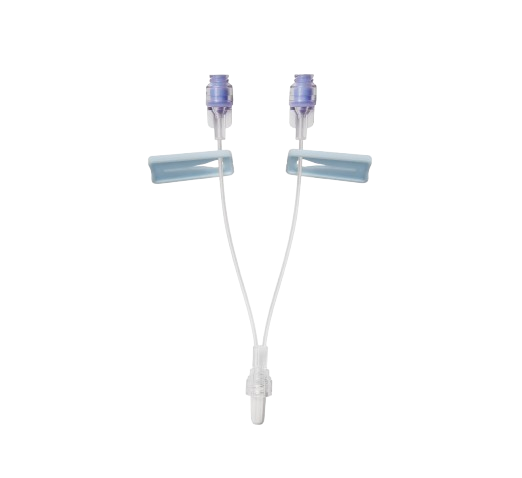
In critical care, anesthesia, and oncology settings, a multiport extension line allows parallel administration of incompatible medications via isolated lines, bolus injections through needle-free ports, and blood draws without disturbing the cannulation site.
5. Choosing the Right Extension Line Configuration
Healthcare procurement and nursing committees should assess the following parameters:
- Priming Volume: Select micro-bore extension lines for pediatric and neonatal therapies to avoid medication wastage and fluid overload.
- Pressure Ratings: Confirm standard gravity infusion versus high-pressure injector compatibility (300 to 325 psi) for radiology contrast procedures.
- Number of Access Channels: Choose single, double (duo), or triple (trio) lumen configurations with integrated color-coded pinch clamps.
- Connector Options: Verify needle-free split-septum valves versus luer-activated valves for optimal microbial barrier efficacy.
- Traceability & Regulatory Dossier: Confirm ISO 13485, CE (EU MDR), and US FDA 510(k) clearances.
6. Common Connection Problems and Practical Solutions
Resolving Infusion Connection Hazards:
Challenge: Micro-cracking of stopcock and extension housings upon contact with lipid emulsions or propofol.
Solution: Standardize on lipid-resistant polycarbonate and polyurethane materials engineered specifically to withstand lipid stress-cracking.
Challenge: Accidental line disconnection during nocturnal patient restlessness.
Solution: Utilize threaded luer-lock extension sets with audible and tactile lock confirmation rather than friction-based slip fittings.
7. Frequently Asked Questions (FAQs)
Q1. Why is compatibility between IV cannulas and extension lines critical?
Compatibility prevents loose connections, air ingress, chemical degradation, and fluid leakage, ensuring prescribed medications enter the vascular system at exact dosages without interruption.
Q2. How can healthcare professionals prevent IV connection leakage?
Ensure ISO 80369-7 luer lock threading, avoid overtightening or misthreading, inspect integrity prior to infusion, and use lipid-resistant connectors for compatible pharmaceutical therapies.
Q3. What parameters must buyers examine before ordering extension lines?
Evaluate inner diameter (micro vs. macro bore), priming volume, burst pressure ratings, DEHP-free polymer certification, valve type, and sterile barrier packaging validation.
Q4. What is the main advantage of a multiway extension set?
It provides multiple dedicated access ports from a single vascular cannulation site, reducing repeated venipunctures while isolating incompatible continuous infusions.
8. Conclusion and Call to Action
Reliable IV therapy depends on seamless component compatibility, leak-proof luer connections, and stringent aseptic care. Choosing engineered infusion lines safeguards patient outcomes while elevating nursing convenience.
Mediplus India Ltd. engineers premium multiway extension lines, needle-free connectors, and IV cannulas with flawless luer-lock fidelity.